Why You Feel Stuck in a Job You Hate
You know you should leave. You've known for months. Here's what's actually keeping you in place, and how to stop mistaking these forces for wisdom.

You know you should leave. You’ve known for months.
And yet here you are, still showing up, still telling yourself it’s not that bad.
If the decision were simple, you’d have already made it. Something is holding you in place with more force than you’re giving it credit for. The question is whether that something is wisdom or just a habit dressed up as caution.
Most of the time, it’s the habit.
Here are six traps that keep good people in bad jobs, and why each one feels like good sense from the inside.
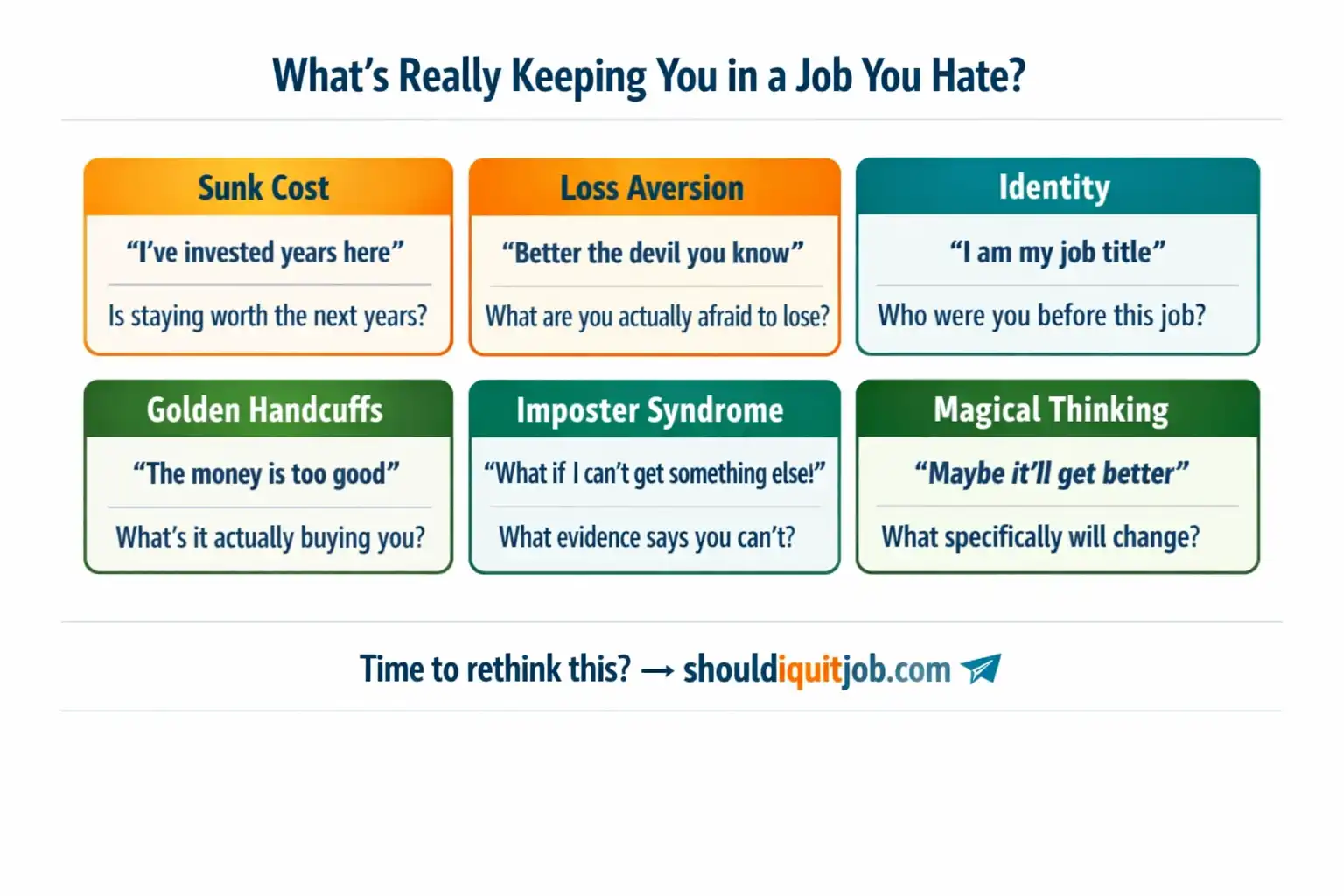
Trap 1: Sunk Cost
“I’ve put four years into this place. Leaving now means it was all for nothing.”
Here’s the thing: those four years are gone either way. Staying doesn’t buy them back, and leaving doesn’t erase them. The only real question is what the next four years look like, and that question doesn’t care what you already spent.
Your brain doesn’t naturally think this way. It treats what you’ve already put in as a reason to keep putting more in, even when the case for staying has quietly gone weak. It’s one of the most reliable ways people talk themselves into another bad year, and it’s worth naming out loud.
The way out: the years are already spent, gone whether you stay or leave. Decide based on what’s ahead, not what’s behind.
Trap 2: Fear Of Losing What You Have
“Better the devil you know.”
Losing something you already have feels far worse than gaining something new feels good, even when the new thing is clearly better on paper. That’s just how people are wired. It’s not a flaw in you specifically.
So the certain loss of your paycheck, your routine, your familiar commute gets weighed heavily against the fuzzy, uncertain gain of whatever comes next. The known thing feels safe. It isn’t always.
The way out: flip the question. Instead of asking what you’d risk by leaving, ask what you’re already losing by staying. Time. Energy. Peace on a Sunday night. That’s a loss too, it just doesn’t show up on a bank statement.
Trap 3: Your Job Became Your Identity
“I’m a [job title] at [company]. Who am I without that?”
For a lot of people, work isn’t just work. It’s the answer to “so what do you do,” the thing that signals who you are at dinner parties and family gatherings. Giving that up feels like giving up a piece of yourself.
But the job title was never really doing the work. You were. What you know, how you think, what you’ve built and shipped and fixed, all of that travels with you. It was never the company’s to keep.
The way out: write down what you’re actually proud of from this job. Notice none of it needs the company name attached to still be true.
Trap 4: Golden Handcuffs
“The money’s too good to walk away from.”
Good pay is a real reason to think twice. That’s not denial, that’s just math, and it’s the same gilded cage problem a lot of people quietly live inside. But it turns into a trap the moment you’re using a vague sense of “I earn well” instead of an actual number.
How much do you really need each month? What’s the real gap between your current lifestyle and a leaner, sustainable one somewhere else? Most people who sit down and do this math find the gap is smaller than the fear made it feel.
The way out: work out the number you actually need to live on. Then decide if what you’re paying to earn above that, in stress, in time, in dread, is worth it.
Trap 5: Doubting You’d Make It Elsewhere
“What if I can’t find anything else? What if I only look good here?”
This fear shows up most in people who are actually good at their jobs, which is a little cruel. The more self-aware you are, the more you notice your own gaps, and the easier it is to assume nobody else would want you.
But the skills, the judgment, the track record: none of that belongs to this specific building. It travels. What’s making you feel barely adequate is the environment, not your actual ability.
The way out: list what you’ve delivered in the last three years. Read it back like it belongs to someone else. Ask if that person would really struggle to find work.
Trap 6: Waiting For It To Fix Itself
“Maybe it’ll get better on its own.”
You’ve been telling yourself this for months. A new project is coming. Leadership might change. A restructure could shake things loose. Something is always almost about to help.
Sometimes things really do improve. More often, what’s actually wrong is baked into how the place runs, and the things you’re waiting on are just ways to avoid deciding anything today.
The way out: name exactly what would have to change for staying to make sense. Then ask honestly how likely that is, and by when. If the answer is “probably not soon,” hope isn’t a plan, it’s a stall.
When You’re Too Tired To Even Try
Here’s the cruel part: the worse things get, the harder it is to do anything about them. If that’s familiar, the fear of quitting piece digs into it more.
Burnout eats the exact energy you’d need to plan an exit. Worry about money narrows your focus down to just getting through today. And feeling worn down chips away at your belief that you’d do well anywhere else. The thing making it urgent is the same thing making it hard to act on.
If that’s you, the first move isn’t a resignation letter. It’s getting stable enough, through rest, support, maybe professional help, to think clearly again. You can’t plan a way out from inside a crisis. Get steady first. Decide after.
The Friend Test
Picture a close friend describing their job to you, word for word the way you’d describe yours. Same complaints. Same stuck feeling.
What would you tell them?
You’re almost certainly a better advisor to them than to yourself. Every trap above works harder on self-assessment than it does on someone else’s situation.
Write that advice down. Read it back like it’s meant for you, because it is. Or skip ahead: the two-minute check asks you exactly what a good friend would.
Ready for your answer?
Get a data-backed verdict in 2 minutes
13 questions. Personalised Leap / Wait / Stay verdict. Financial runway analysis. Basic report free · Full analysis available · No login required.
Analyse My SituationThis content is for informational purposes only and does not constitute professional financial, career, or psychological advice. If you're experiencing symptoms of depression, anxiety, or burnout, please speak with a qualified health professional.