My Job Gives Me Anxiety: Should I Quit?
There's a difference between normal work stress and job-induced anxiety that's genuinely harming you. Here's how to tell them apart, and what to do next.

It’s Sunday, around 6pm. You’ve had a good weekend: slept well, saw people you like, went a whole stretch without thinking about work at all.
Then something shifts. The light changes, or you glance at the clock, or a work notification flashes up that you don’t even open. And there it is: a tightness in your chest, a low hum of dread that wasn’t there an hour ago.
You spend the rest of the night half there, already bracing for Monday.
If that sounds familiar, you’re not being dramatic, and you’re not the only one. The real question isn’t just “should I quit?” It’s whether what you’re feeling is normal stress that comes with most jobs, or whether this specific job has become an actual anxiety trigger. Those are two different problems, and they need two different responses.
Normal Stress vs. Something the Job Is Doing to You
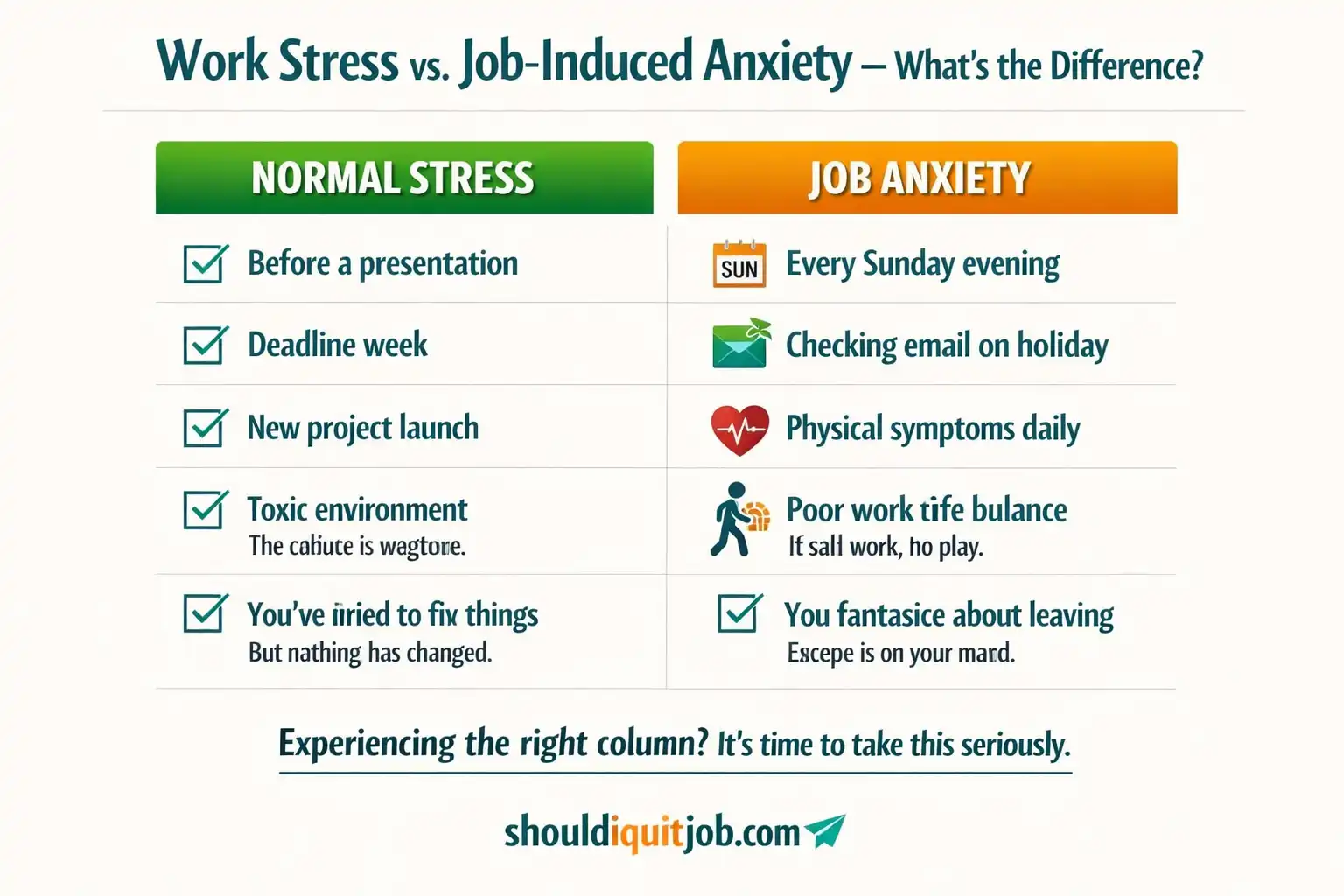
Work stress is real, and within reason, normal. A big presentation gives you nerves. A tight deadline creates pressure. A hard conversation with your manager leaves you rattled for the afternoon. It’s tied to something specific, and once that thing passes, the feeling passes with it.
Job anxiety behaves differently. It doesn’t need a trigger. It sits in the background all week and ramps up every Sunday night no matter what’s actually on for Monday. It leaks into your personal life in a way ordinary stress doesn’t, and it shows up physically: tight chest, bad sleep, an alertness that never fully switches off.
The clearest test: does it have an off switch? If you feel noticeably better on weekends and holidays, and that relief is specifically about not being at work rather than just being rested, the job itself is the source.
Four Kinds of Job Anxiety
Job anxiety isn’t one single thing, and which kind you’re dealing with changes what actually helps.
From overwork. The job asks for more than you can sustainably give. You’re always behind, or terrified of falling behind. It usually builds slowly: you adjusted each time the load crept up, until the current pace felt normal even though it isn’t. The tell: your anxiety tracks your workload, easing off in quiet stretches, except there are no quiet stretches left.
From conflict. A difficult manager, a hostile colleague, a team dynamic that’s political or unkind. The dread is specific and social: certain people, certain meetings, certain conversations you can see coming. The work itself might feel fine. This one often hurts the most because it feels personal. Usually it isn’t.
From insecurity. Restructures, redundancy rumors, a review that didn’t go well. It’s anticipatory, dread about something that hasn’t happened yet, and it usually comes with constant monitoring: reading tone in every message, hunting for signals about where you stand.
From misalignment. You’re doing work you don’t believe in, for a company whose values don’t sit right, going against your own judgment more than feels comfortable. Quieter, easy to mistake for ordinary stress, but with a moral weight to it: less fear, more a low, steady wrongness you can’t quite name.
Five Things Worth Trying Before You Quit
If the anxiety is real but you’re not at a breaking point, there are options worth trying before a full exit.
- Talk to someone at work. Your manager, if that feels safe, or HR if it doesn’t. Go in to problem-solve, not vent, and ask directly about workload, flexibility, or a different mix of work.
- Cut your scope or hours. A temporary reduction, stepping back from one project, going part-time. More workplaces allow this than people assume.
- See a doctor or therapist. Support during a hard stretch genuinely helps, and a doctor can also point you toward medical leave if it comes to that.
- Change how you work, not just what you do. Remote days, a different start time, anything that cuts the friction around the commute.
- Take medical leave. More available than people realize. A doctor can often sign off on stress leave fairly easily, and it can interrupt a spiral before it gets worse.
When Quitting Is Actually the Right Call
Sometimes the anxiety isn’t going to resolve with any adjustment. Here are four signs the job itself is the problem, and no internal fix changes that.
- It’s tied to something structural. Your manager’s behavior, the company’s culture, the basic nature of the role. None of that shifts because of one good conversation with HR.
- You’ve already tried to fix it. The conversations happened, the adjustments were made, time passed, and the anxiety is the same or worse. Some workplaces produce anxiety as a built-in feature. You can’t out-cope an environment like that.
- It’s getting worse, not better. If anxiety that was manageable six months ago is now touching your sleep, your relationships, or your ability to function outside work, staying has stopped being neutral.
- You can’t picture it improving. Not pessimism, just honesty. There’s no believable story for how this gets better from here. If you can’t sketch it, that’s your answer.
The Money Question
The tricky part of leaving because of anxiety is that financial stress makes anxiety worse, not better. Watching savings drain fast becomes its own source of dread.
Work out your runway before you go. Add up your monthly costs, rent, food, bills, subscriptions, multiply by how many months you’d realistically need before income resumes, then add 20 percent as a cushion.
A rough guide:
| Your next step | Minimum runway | Recommended |
|---|---|---|
| Job lined up before leaving | 1 month | 3 months |
| Job searching after leaving | 3 months | 6 months |
| Freelancing or consulting | 6 months | 9 months |
| No plan yet | 9 months | 12+ months |
If you’re not there yet, that doesn’t mean sit tight indefinitely. It means you have a number to hit. Job search quietly while you build toward it, that’s the safer path for most people. And if the anxiety is bad enough that working is actively hurting your health, talk to a doctor first. Medical leave can buy you both time and income while you work out what’s next.
Just to Say This Plainly
If you’ve spent months telling yourself to toughen up, you can stop.
Ordinary work stress is normal. Anxiety that disrupts your sleep, follows you home, and turns Sundays into dread isn’t the price of having a job. It’s a real problem, worth taking seriously.
The goal was never to quit at the first hard week. It’s figuring out whether this is a rough patch or a sign something needs to change. If you want a clearer read than gut feeling gives you, running the numbers on your situation takes about two minutes.
You’re not being weak. You’re paying attention.
Ready for your answer?
Get a data-backed verdict in 2 minutes
13 questions. Personalised Leap / Wait / Stay verdict. Financial runway analysis. Basic report free · Full analysis available · No login required.
Analyse My SituationThis content is for informational purposes only and does not constitute professional financial, career, or psychological advice. If you're experiencing symptoms of depression, anxiety, or burnout, please speak with a qualified health professional.