The Quit Number: How Much You Need to Quit
Most people guess when it comes to the finances of quitting. Here's how to calculate the actual number, and why most people get it wrong.

Most people decide to quit with their gut, then scramble to work out the money part afterward, guessing at numbers and hoping for the best. That’s usually where things go wrong.
Not the decision itself - leaving might be exactly right. It’s the financial planning that trips people up. They underestimate what they’ll need, walk out too early, and end up making their next move from panic instead of choice.
Here’s how to work out your real number. For the fuller picture beyond just the money, the two-minute assessment looks at everything together.
The Basic Formula
Your quit number is the total amount you need saved before you can leave safely.
Three pieces make it up.
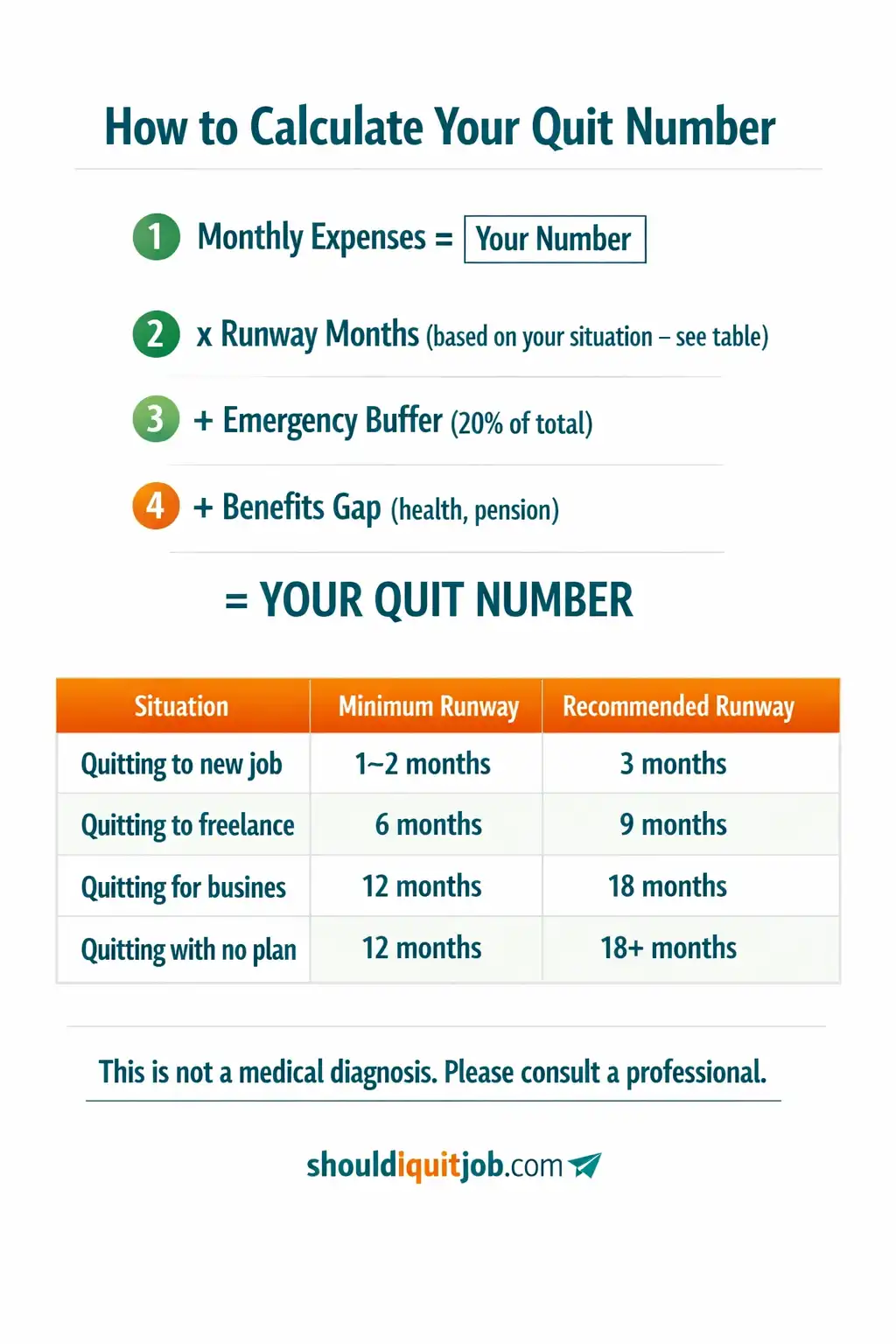
Monthly costs, times however many months you need. Add up everything you spend in a normal month - rent, food, bills, transport, subscriptions, debt payments, all of it - then multiply by how many months you’d need to cover before income starts again. That’s your base.
What your job quietly pays for. This is the part almost everyone forgets. Your employer is covering things you don’t think about: pension contributions, health cover, maybe a travel pass, life insurance. Once you leave, you’re either paying for these yourself or going without. For most salaried people that adds another 15 to 25 percent onto their real monthly cost.
A cushion on top. Add 20 percent to the whole thing. Job searches run long, freelance invoices get paid late, and something unplanned always seems to show up right when you can least afford it. This isn’t pessimism. It’s what keeps the plan from falling apart the moment reality doesn’t match the spreadsheet.
Quit number = (monthly costs + what your job was covering) × runway months × 1.2
What “Runway” Really Means
Runway is how many months you’d realistically go between your last paycheck and your next one.
Most people guess too low. They picture the best case, the offer that lands in week three, instead of a fair middle estimate, and they’re naturally hopeful about how fast things move.
Here’s a more honest breakdown, based on what you’re actually doing next.
| Your next step | Minimum runway | Recommended |
|---|---|---|
| New job already accepted before leaving | 1 month | 3 months |
| Job searching after leaving | 3 months | 6 months |
| Freelancing or consulting | 6 months | 9 months |
| Starting a business | 12 months | 18 months |
| No plan yet | 12 months | 18+ months |
The minimum column is the bare floor, what you’d need if everything breaks your way. The recommended column gives you room to actually be selective, and to survive whatever doesn’t go to plan.
The Benefits Gap Nobody Budgets For
If you’re in the US and your job covers health insurance, this is the number that changes everything. Replacing it through COBRA usually runs $500 to $800 a month for one person, money you weren’t spending before, so plan for it from day one.
In the UK, healthcare isn’t tied to your job, but your pension contributions are. If your employer was matching 5 percent of your pay, that’s real money disappearing the day you leave - work out what it’s worth monthly and fold it into your number.
Other things people forget: life insurance through work, income protection, dental or vision cover. Go through your benefits statement and put a monthly price on each item - the total tends to be bigger than people expect.
Ways Your Runway Can Run Out Faster Than Planned
Your number assumes things go roughly to plan. Here’s what happens when they don’t.
The search takes twice as long as you thought. A normal job search runs 3 to 6 months. If yours stretches to 9 and you only planned for 6, that’s three extra months coming straight out of savings - exactly what the 20 percent cushion is for.
Freelance or business income starts slow. Nobody’s first client shows up in week one, and most new businesses need 12 to 24 months to become sustainable. Read more on what a realistic runway for starting a business actually looks like. Assuming you’ll be the exception is a bet, not a plan.
Something breaks. A car repair, a flight home for a family emergency, a medical bill. Without a paycheck absorbing it, one unplanned £2,000 hit lands directly on your runway.
The next thing turns out not to be it either. You leave, start looking, and realize you don’t want another job just like the last one. Figuring out what you actually want takes time, and that time comes out of the same pot.
The cushion covers most of this. But building toward the recommended number instead of the bare minimum is your real protection.
A Real Example
Here’s what it looks like with actual numbers.
Monthly costs: £2,500 What the job was covering (pension, insurance): £300 extra a month Real monthly burn: £2,800
Situation: leaving to job search, nothing lined up yet. Recommended runway: 6 months.
£2,800 × 6 = £16,800 Add the 20 percent cushion: £16,800 × 1.2 = £20,160
That’s the number. Not a guess, the actual amount that makes leaving genuinely lower-risk.
Same person, freelancing instead: £2,800 × 9 = £25,200 × 1.2 = £30,240
Starting a business: £2,800 × 18 = £50,400 × 1.2 = £60,480
The number moves a lot depending on what comes next - which is why “how much do I need to quit?” only has an answer once you know “and then what?”
If You’re Not There Yet
Most people who run this calculation find out they’re short. See quitting without another job lined up for what that looks like in practice. That’s not a dead end, just your starting point.
Try a 90-day sprint. Work out the gap between what you have and your number, divide it by three, and that’s your monthly savings target for the quarter. What would have to change to hit it - costs to cut, income to add, something to sell?
Start looking quietly while you’re still employed. The best time to look for your next job is before you desperately need one. You get to be picky, and you get real leverage on salary.
Medical leave, if it applies. If health is part of why you’re leaving, it can buy you income while you build your runway properly. That’s not gaming anything, it exists for exactly this situation.
Stay one more year, on purpose. If you’re genuinely far from your number, a year of focused saving with a real target and exit date beats staying indefinitely.
Working out your quit number isn’t about talking yourself out of leaving. It’s about leaving with your eyes open - knowing exactly where you stand, ready now or a clear distance from ready. Either way beats guessing.
Ready for your answer?
Get a data-backed verdict in 2 minutes
13 questions. Personalised Leap / Wait / Stay verdict. Financial runway analysis. Basic report free · Full analysis available · No login required.
Analyse My SituationThis content is for informational purposes only and does not constitute professional financial, career, or psychological advice. If you're experiencing symptoms of depression, anxiety, or burnout, please speak with a qualified health professional.