Should I Quit My Job to Start a Business?
The question isn't whether your business idea is good. It's whether it's consistent enough. Here's how to know when you're actually ready to go full-time.

I know someone who quit her job the week her side business hit $3,000 in a single good month. She was so excited she didn’t stop to ask if that month was normal.
It wasn’t. The next three months were half that. She was back job hunting by winter, and the business she’d been so proud of quietly folded a few months later.
The idea wasn’t bad. The timing was. She quit on a spike, not a pattern, and there’s a real difference between the two.
Here’s how to tell which one you’re actually looking at.
Ask If It’s Consistent, Not If It’s Good
Almost everyone can point to one great month, one big client, one viral post that brought in a wave of sign-ups. That’s not proof of anything except that it can happen once.
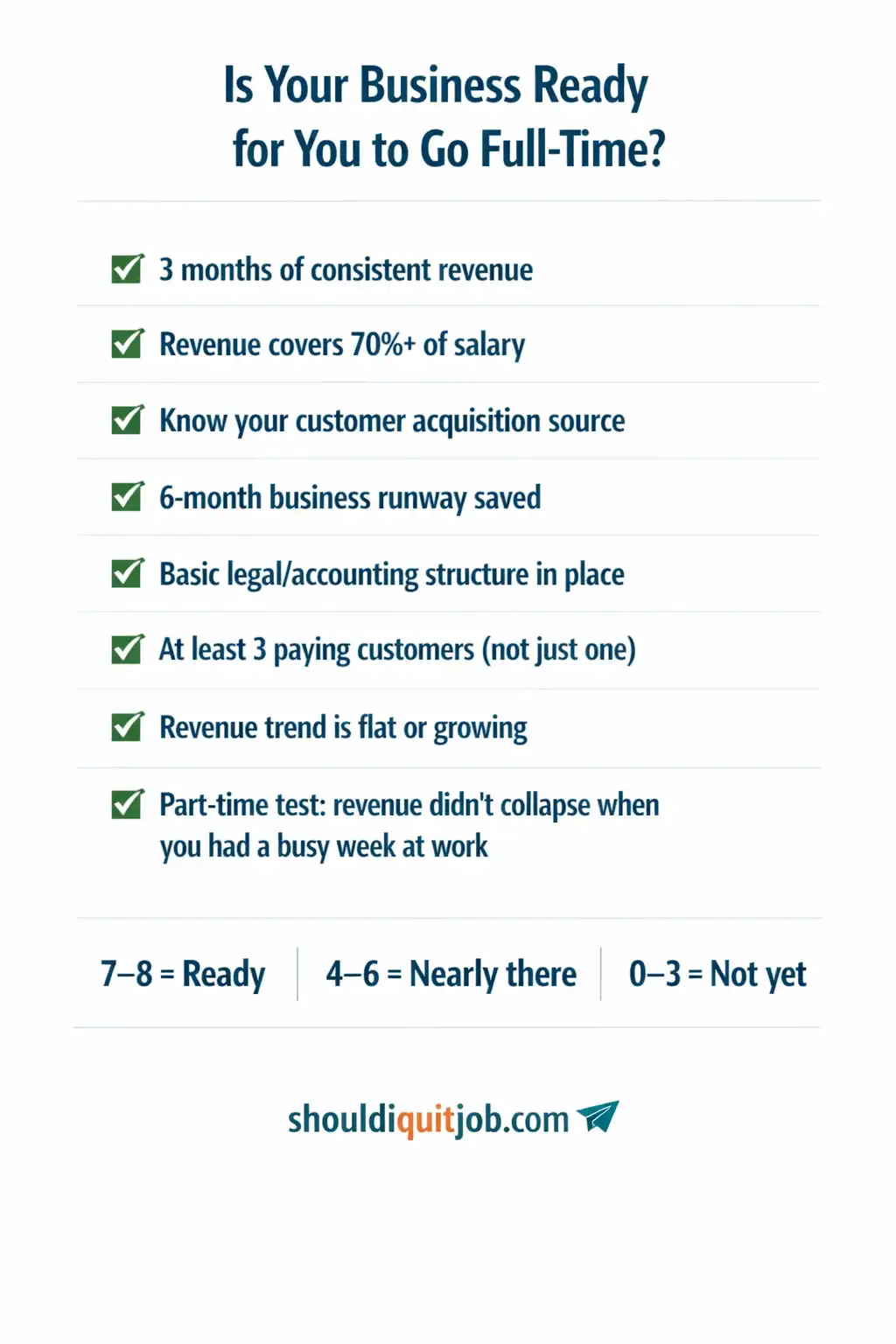
What actually tells you something is three months in a row of real money landing in your account. Not interest. Not people saying they’d love to work with you someday. Money that showed up, three times running.
Then look at the direction. Is it growing month to month, holding steady, or slipping? A flat three months is a very different signal from a declining one, and either is different from three months of growth.
And ask yourself the question most people skip: do you actually know where each customer came from? If you can’t answer that, you can’t predict where the next ten will come from either, and you definitely can’t promise yourself that going full-time will bring in more of them.
You Need More Than Your Salary
This trips people up constantly. Your paycheck isn’t the number to replace. Your paycheck plus everything your employer was quietly covering is.
Think about what disappears the day you leave: pension or retirement contributions, a chunk of your tax handled differently, maybe health cover, maybe equipment you never had to buy.
A decent rule of thumb is aiming for 70 to 80 percent of your current gross salary in business revenue before quitting starts to make financial sense. That number has to stretch to cover your living costs, the higher tax bill that comes with self-employment, any benefits you’ll now be buying yourself, and basic costs of running the business.
Fall short of that and you’ll end up quietly draining savings to cover the gap. Which shortens your runway right when you need it most, and puts you in the position of making decisions about your new business while stressed about money. That’s a bad combination.
Four More Things Worth Having in Place
Consistent revenue matters most, but it’s not the whole picture.
Build a six-month runway that lives inside the business, separate from your personal savings. Enough to cover tools, software, and a couple of slow months without you having to dip into your own account. Blurring business and personal money is one of the quietest ways the math falls apart early on.
Check whether your customer pipeline depends on you being constantly available. If every sale so far has come from a conversation you personally started in whatever spare hours you had, going full-time might help. It might also just reveal that the channel was never going to scale on its own.
Count your customers, not just your revenue. Three paying clients tells you something different than one big one does. If nearly everything comes from a single client, what you actually have is a good freelance gig, not yet a business, and that’s worth knowing honestly.
Get the boring stuff sorted before you need it: a separate business account, basic bookkeeping, a clear sense of what you’ll owe in tax and when, contracts if you’re working with clients. Nobody enjoys this part, but the people who struggle most in year one are usually the ones who put it off.
Three Ways to Actually Make the Move
Quit outright. Pick a date, hand in your notice, commit fully. It’s the riskiest route, but it also forces total focus. When the income has to come from the business, it often does.
Negotiate part-time first. More employers say yes to this than people expect, especially if you’re good at what you do. Dropping to three or four days a week keeps some income flowing while you give the business real, dedicated time. It’s the gentler version of the same move.
Take a break instead of quitting. Some employers offer unpaid leave or a career break, especially larger ones. That can buy you six to twelve months to properly test the business, with a job to come back to if it doesn’t work out. Worth asking about even if you assume the answer is no.
Which one fits depends on how ready the business already is and how flexible your employer turns out to be.
A Realistic Walkthrough
Priya runs a freelance design practice alongside her full-time job. Her last three months brought in $1,100, $1,400, and $1,650, climbing steadily. Four clients, and she can name exactly where each one came from: two through content she posts online, one referral, one from a talk she gave.
Her salary is $2,500 a month before tax. Seventy percent of that is $1,750, so she’s close but not quite there.
Her employer’s open to flexible hours, so she drops to four days a week for a modest pay cut. That frees up a full extra day for client work every single week.
Six months later her business is bringing in $2,600 a month. She has a six-month runway saved separately, and she knows exactly where her clients come from. She quits, and none of it is a guess.
The Question That Cuts Through the Noise
Would you bet your own savings that this business reaches stable footing within eighteen months of going full-time?
A confident yes means you’re probably ready, or close enough to start planning seriously.
A hopeful maybe means the business needs more time to prove itself while you’re still employed. Run the free 2-minute analysis to get a clearer read on your specific numbers and timing. What you’re protecting by waiting isn’t opportunity, it’s the runway you’ll actually need if the first year doesn’t go to plan.
Ready for your answer?
Get a data-backed verdict in 2 minutes
13 questions. Personalised Leap / Wait / Stay verdict. Financial runway analysis. Basic report free · Full analysis available · No login required.
Analyse My SituationThis content is for informational purposes only and does not constitute professional financial, career, or psychological advice. If you're experiencing symptoms of depression, anxiety, or burnout, please speak with a qualified health professional.