Signs Your Job Is Actually the Problem (Not You)
Many people spend years trying to fix themselves for a job that was never right for them. Here's how to tell a personal failing from a bad environment.

There’s a specific kind of misery that comes from years in the wrong job.
It isn’t just being unhappy at work. It’s confidence wearing away a little at a time. A creeping sense that you’re less capable than you thought. The way you start shrinking, first at work, then slowly everywhere else.
The cruel part is that good, conscientious people almost always blame themselves first. Not the job. Themselves.
They work harder. Try to adapt. Take every piece of feedback to heart. Assume there’s some flaw in them to fix. And they spend months, sometimes years, fixing things that were never broken, for a place that was never going to be right for them anyway.
Here’s how to tell if it’s actually the job.
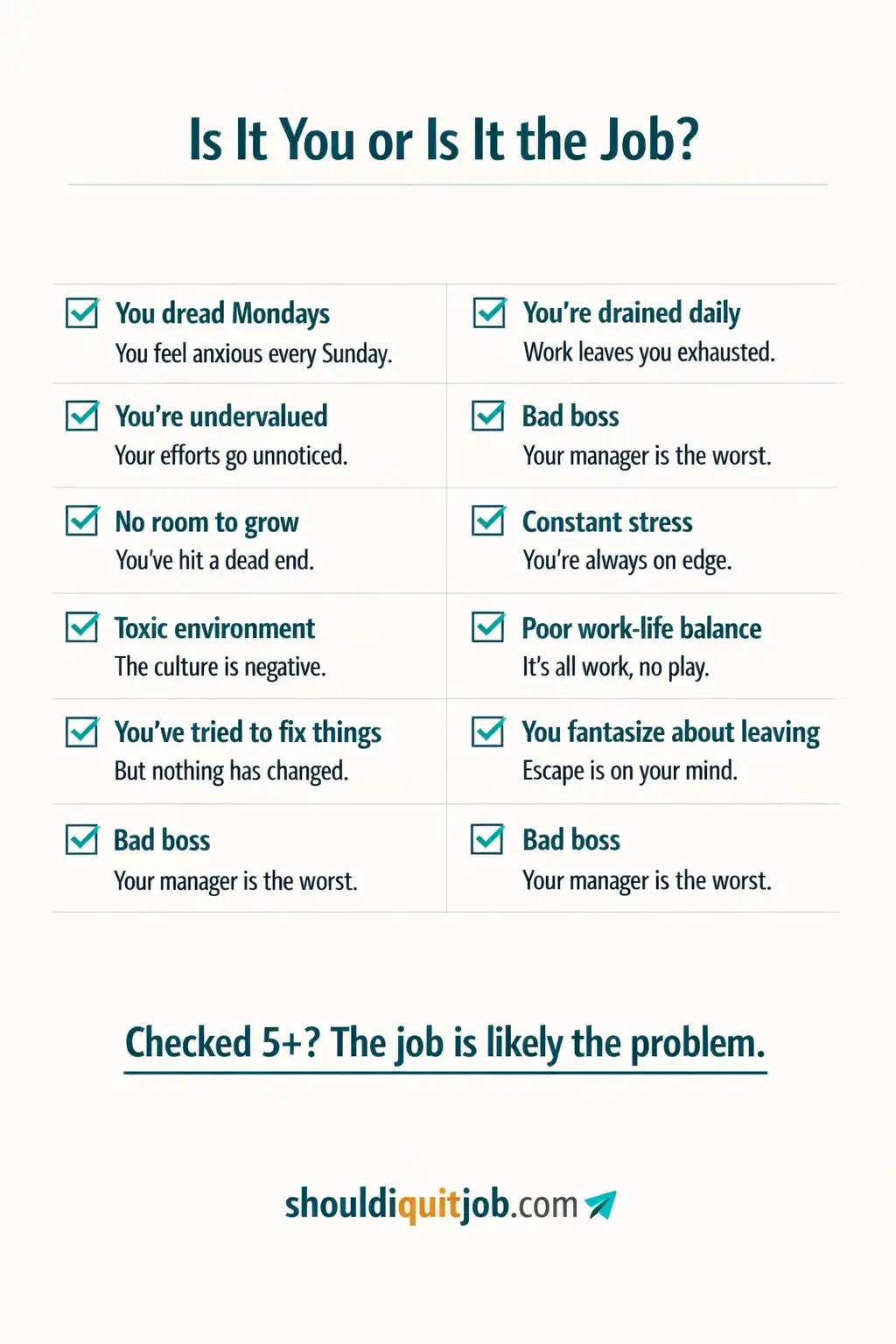
Ten Signs It’s the Job, Not You
1. Your body keeps score by the calendar. Headaches that show up Monday and vanish by Saturday. Sleep that gets worse all week and improves the second you’re off. Tension in your neck or chest you don’t even notice on weekends. That’s not you being dramatic. That’s a stress response, recovering the moment the stressor is gone.
2. You’re sharp everywhere except here. You handle hard things in your personal life without much trouble. You’re competent in basically every other room you walk into. But in this job, you constantly feel like you’re falling short. Incompetence that only shows up in one place usually isn’t about you.
3. The same work, somewhere else, wouldn’t feel like this. Strip away the culture, the manager, the politics, and just picture the actual tasks. If you imagine doing that exact work somewhere else, does the dread lift? If yes, the work is fine. The place isn’t.
4. Good people keep leaving quietly. When colleagues you respected, people who seemed settled and capable, start exiting without much noise, pay attention. Quiet departures usually mean someone spotted something systemic and decided not to fight it.
5. You’ve genuinely tried, and nothing moved. You had the hard conversation. You adjusted how you worked. You asked directly for what you needed. Same result, maybe worse. When real effort changes nothing, the problem usually isn’t yours to fix. If that’s where you’re at, this is worth reading before you decide anything else.
6. Your manager keeps the wins and hands you the losses. Your work goes upward without your name attached. When something breaks, it lands on you. When something works, it lands on them. That’s a pattern, not a misunderstanding, and it won’t fix itself with better communication on your end.
7. There’s genuinely nowhere to go. You’ve delivered. You’ve asked about growth. You keep hearing “soon,” or the target quietly moves the moment you reach it. Two-plus years in the same seat with no real movement isn’t bad luck. It’s the structure telling you something.
8. The job you took isn’t the job you have. You were hired for one thing and spend your days doing another entirely. A small gap between the pitch and the reality is normal. A large one is closer to being misled.
9. Reviews leave you smaller, not sharper. Not challenged in a useful way, just worse. Goalposts that move, feedback about things you didn’t know were even being judged. Good feedback makes people feel more capable. If yours keeps making you feel less capable, that’s not oversensitivity.
10. You’re a different person here than everywhere else. Confident and direct at home, guarded and hesitant at work. That gap is being manufactured by the environment, not revealing who you really are. It’s how you learned to get through the day there. Understanding that pattern can make it easier to trust what you’re seeing.
Why Good People Default to Blaming Themselves
If most of that list sounded familiar, you probably already suspected something was off. So why haven’t you trusted it?
Because the habit of blaming yourself first runs deep in people who care about doing well.
Conscientious people assume that when something’s going wrong, they must be the variable. They pick apart their own behavior. Look for what they could have done differently. Absorb feedback even when it’s inconsistent or unfair.
It feels responsible to assume the fault is yours. But there’s a line where that instinct stops helping and starts hurting, where you’re trying to repair something in yourself that was never actually broken.
The worst environments are often the best at making this feel true. High expectations, constant feedback, shifting targets: it all quietly teaches people to just try harder. That keeps them in place. And it keeps them quiet about what’s actually happening.
A Quick Exercise Worth Doing
Write down five moments from the last month that made you feel bad at work.
Next to each one, name who or what actually caused it.
Then look for a pattern. Does one name keep showing up? Does the same dynamic repeat itself? Or is it scattered randomly, with no thread connecting any of it?
Patterns point straight at where the problem actually lives.
If your own name shows up most of the time, “I missed that,” “I could’ve handled it better,” take that seriously and look honestly at what’s yours to work on.
If other names keep showing up, or the same structural mess repeats itself, stop trying to fix yourself. You’re not the variable.
One More Thing
You don’t need airtight proof before you’re allowed to act.
A lot of people get stuck waiting to rule out every possible way they could be at fault before they’ll even consider leaving. That standard doesn’t actually apply to how a workplace behaves.
A place doesn’t need to be a disaster to be wrong for you. A manager doesn’t need to be a villain to still be steadily eroding your confidence.
If this list felt familiar, you’re probably not the problem. The free 2-minute analysis can help turn that recognition into an actual next step, weighing your finances, your energy, and your options together.
That’s worth knowing. What you do with it is a separate decision.
Ready for your answer?
Get a data-backed verdict in 2 minutes
13 questions. Personalised Leap / Wait / Stay verdict. Financial runway analysis. Basic report free · Full analysis available · No login required.
Analyse My SituationThis content is for informational purposes only and does not constitute professional financial, career, or psychological advice. If you're experiencing symptoms of depression, anxiety, or burnout, please speak with a qualified health professional.