If You Stay 1 More Year: What Will Change?
Most people stay hoping something will change. Here's an honest look at what staying another year actually means, and how to make it count if you do.

Before you decide anything, sit with one question.
If you stay another year, what, specifically, will be different?
Not vaguely different. Name the actual thing.
Most people can’t. They’re carrying a hope: that it’ll get better, that the job will become bearable, that something will just shift on its own. Push for specifics and the honest answer is usually that nothing changes unless you’re the one who changes it.
That’s the question worth sitting with before you decide to stay.
Five Things a Year Can Actually Change
These are the areas where another year, spent on purpose, genuinely moves something.
Your savings. This is the most concrete upside of staying deliberately. Every month you’re employed, your quit number gets a little closer. If you’re short of your target, a year of focused saving with a real exit date attached can close that gap completely. Staying with a number in mind is nothing like staying with no plan at all.
Your skills. If the role is still stretching you at all, a year builds things that travel with you. This takes some intention: not just showing up, but picking the one or two skills worth building and actually chasing them.
Your network. More time means more relationships, more people who’ve seen your work. This matters more than people give it credit for. Most good jobs come through people you know, not job boards. Every extra year you’re in the industry, that circle gets a bit wider and a bit stronger.
Your clarity about what’s next. People underrate this one. If you’re not sure yet what you’re actually moving toward, a year spent paying real attention to that question tends to produce answers. Talk to people outside your team. Try different kinds of projects. Figure out what you want, so that when you do leave, you’re heading somewhere instead of just running from something.
Your leverage where you are. If there’s still room to move up, a raise, a promotion, a better project, and you genuinely think it’s within reach, a focused six-month push before you reassess is worth making.
Three Things a Year Almost Never Changes
Here’s the part people don’t want to hear.
Your manager. Unless they leave, get moved, or have some real specific reason to change, they’ll be roughly the same person a year from now. If your manager is the main reason you’re unhappy, waiting around for them to improve is a bet that rarely pays off.
The culture. Culture flows from the top and gets baked into the systems, the incentives, the stories people tell about who gets ahead. A year doesn’t touch that. Leadership changing might. Time alone won’t.
How the job makes you feel. If the work drains you, bores you, or just doesn’t sit right with what you care about, that feeling doesn’t usually fade with time. It builds. Month 37 of work that doesn’t engage you isn’t meaningfully better than month 24.
Be honest with yourself about these three. If they’re the real source of your unhappiness, another year isn’t likely to fix anything. It’s likely to stretch it out.
Staying on Purpose vs. Staying by Default
There are two very different ways to spend another year in a job you’re unhappy in.
The default stay. You’re unhappy, but there’s no real plan. You stay because leaving feels too complicated or too risky right now. The year passes. You’re in the same spot, except you’ve now spent another year building toward nothing in particular.
The intentional stay. You’ve made an actual decision. You’ve got a target, a number, a skill, a date, and you’re using the year to reach it. You’re quietly job hunting in parallel. You’re building your runway. The next twelve months are preparation for a move you’re going to make, not an open-ended holding pattern.
From the outside these look identical. From the inside they’re completely different. And they lead to completely different places.
How to Actually Use the Year
If you’ve decided to stay, or the assessment pointed you toward staying for now, here’s a rough way to spend the twelve months.
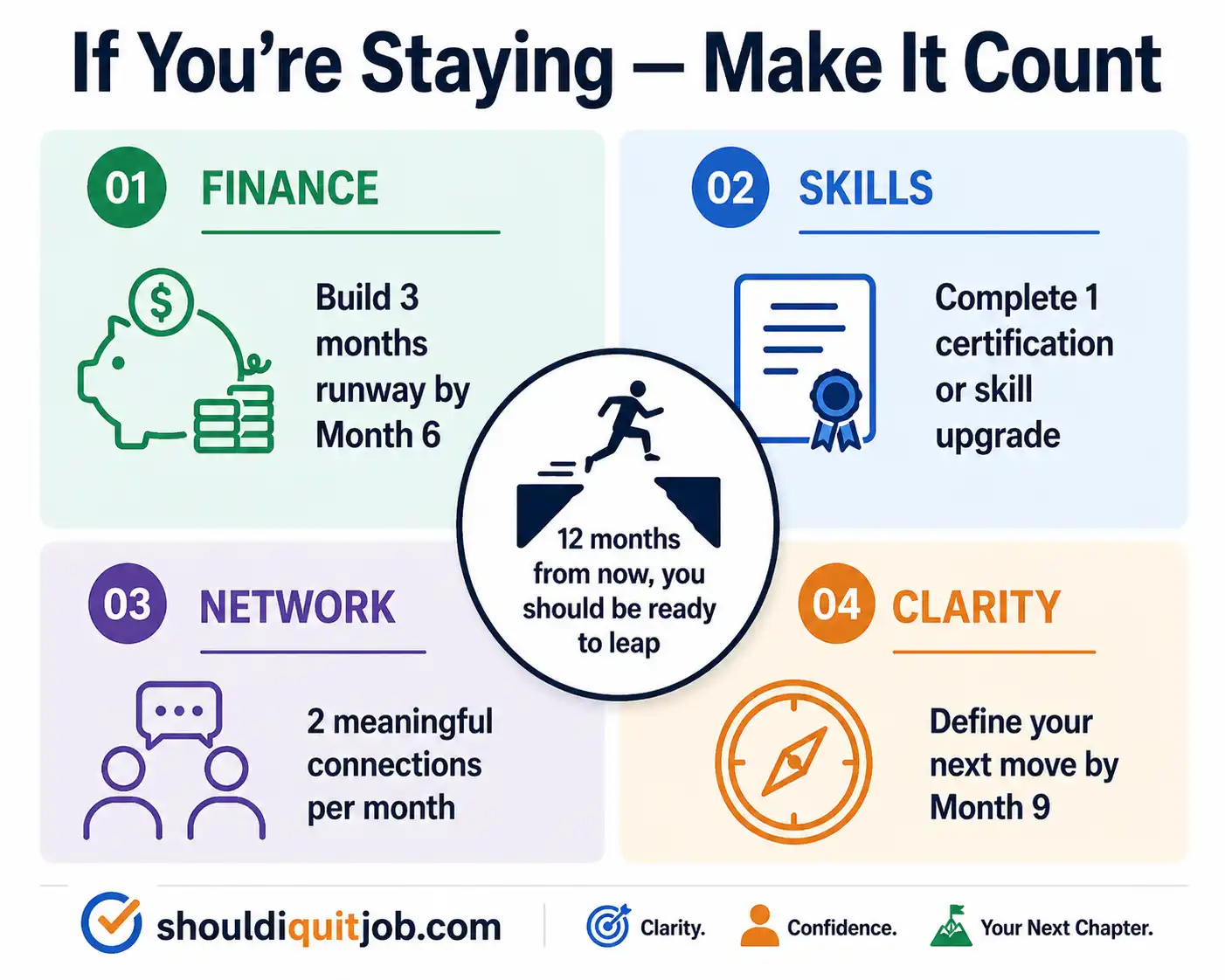
Months 1-2: Get your numbers straight. Work out your quit number exactly. Set a monthly savings target. Open a separate account, name it something obvious, and automate the transfer on payday.
Months 3-4: Close a skill gap. Pick the one or two skills that would most improve your position when you leave. Start on one now, whether that’s a course, a certification, or just a different kind of project inside your current role.
Months 5-6: Build your network. Aim for two real professional conversations a month. Not networking for the sake of it, genuine conversations with people doing work that interests you. This is groundwork for the search you’ll run later.
Months 7-8: Get specific about direction. By now you should have enough to work with. What kind of role, what kind of company, what kind of work. Specific enough to actually search for.
Months 9-10: Start a quiet search. Not desperate, deliberate. A handful of well-aimed applications a week. Lean on your network before job boards.
Months 11-12: Get ready to move. By month 11, the goal is to be in a position to go, whether or not the perfect thing has landed yet. References ready, CV strong, network warm, savings at target.
You might leave before the twelve months are up. That’s fine. The point was never to hit exactly month twelve. It’s to be ready the moment the right thing shows up, instead of scrambling when it does.
A Question Worth Revisiting
Write this down somewhere and come back to it every few months.
“What specifically will be different in six months if I stay?”
If the answer keeps getting sharper, “I’ll have the skills for this kind of role,” “I’ll have hit my number,” you’re using the time well.
If the answer stays fuzzy, or it’s still just “I’m hoping things improve,” that tells you something too.
And if you’re no longer sure staying is even the right call, retake the assessment and see what it says now.
Ready for your answer?
Get a data-backed verdict in 2 minutes
13 questions. Personalised Leap / Wait / Stay verdict. Financial runway analysis. Basic report free · Full analysis available · No login required.
Analyse My SituationThis content is for informational purposes only and does not constitute professional financial, career, or psychological advice. If you're experiencing symptoms of depression, anxiety, or burnout, please speak with a qualified health professional.