You Don't Hate Your Job - You Hate This One Thing
Most people who want to quit their job don't hate the job itself. They hate one specific part of it. Finding that part changes everything.
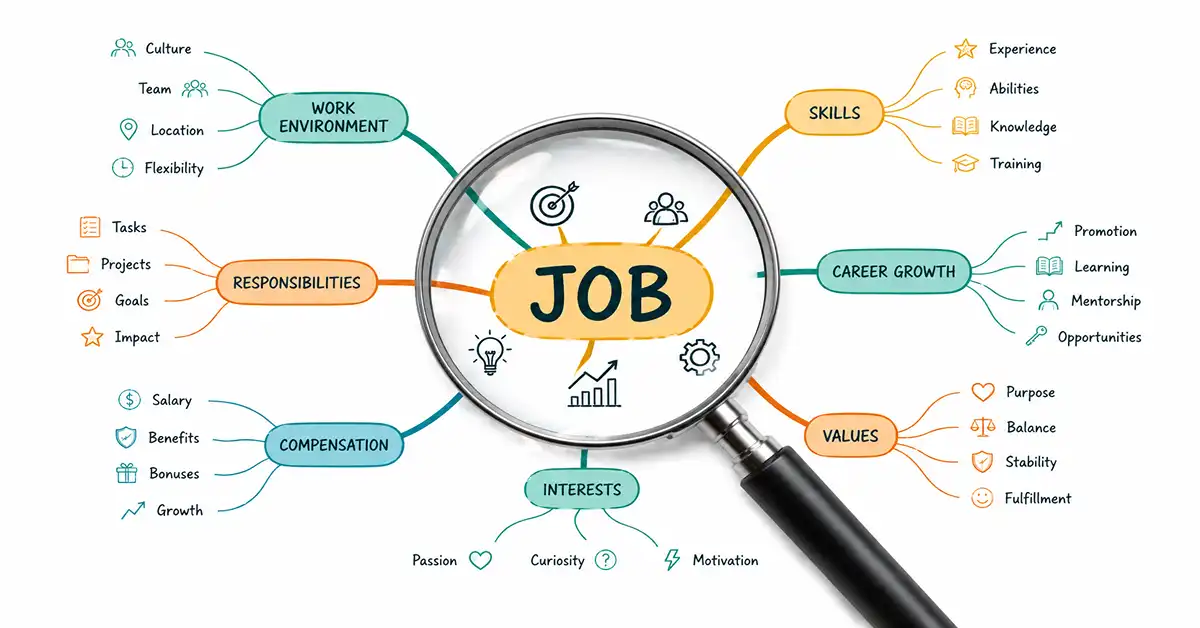
Before you hand in your notice, answer one question honestly.
What specifically is making you miserable?
Not “everything.” Not “the whole thing.” Something specific. Because if you can name it, you might not need to quit at all. And if you can’t name it yet, that’s worth figuring out before you make any big moves.
Most people who say they hate their job don’t actually hate the job. They hate one piece of it. One person, one situation, one thing quietly poisoning everything else around it.
The trouble is, once you’re deep in it, everything starts to feel bad. The work feels bad. The people feel bad. Monday mornings feel bad. It all blurs into one heavy cloud, and it gets nearly impossible to see clearly from inside it.
Here’s how to cut through that. Or for a broader read before you dig into the specific piece, the two-minute check looks at all six factors at once.
Your Job Isn’t One Thing
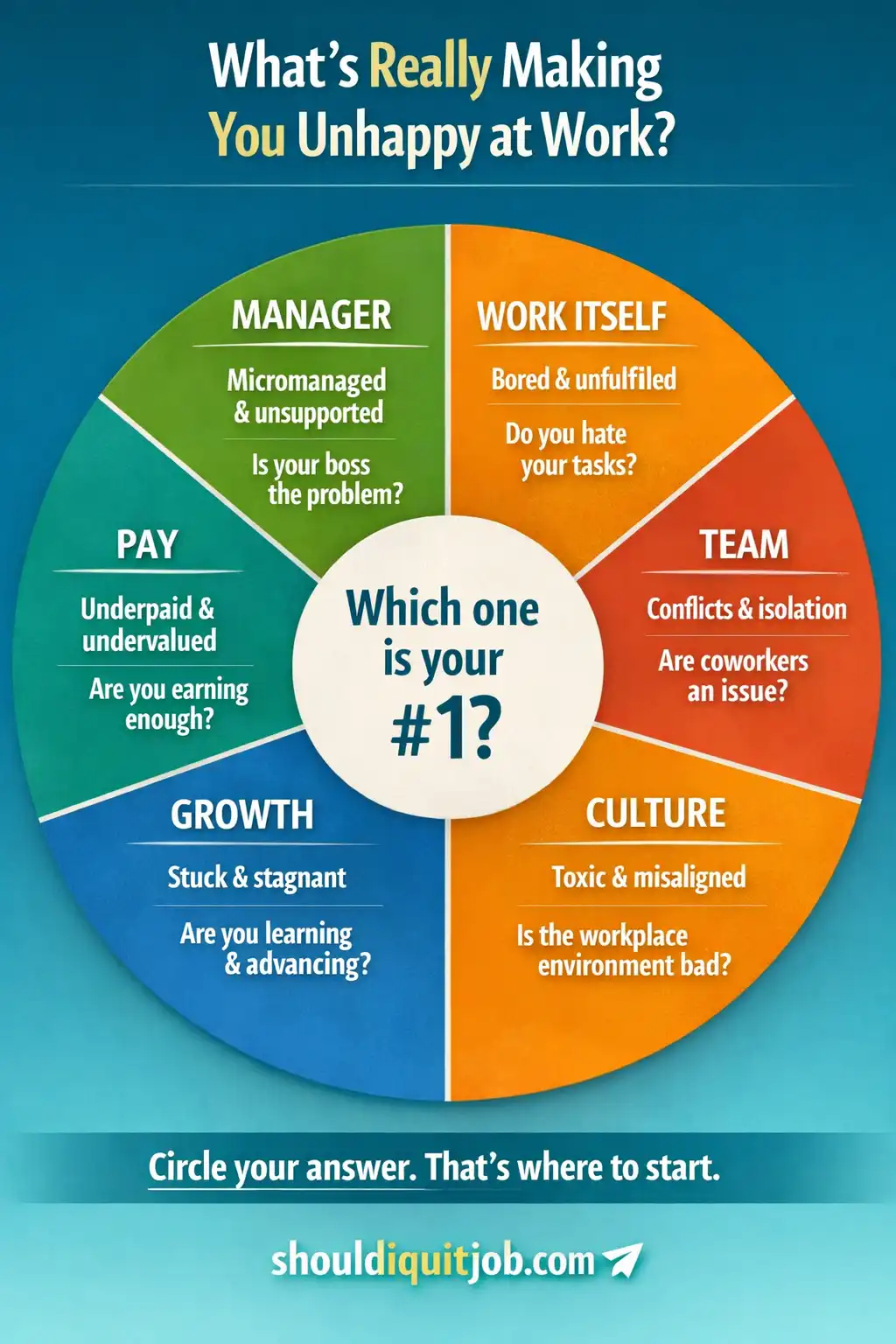
Your job is actually six separate things stacked together. Each one can be good or bad, completely independent of the others.
The work itself. What you actually do all day, from opening your laptop to closing it. Do the problems interest you? Do you care about what you’re making or fixing?
Your manager. The single biggest lever on how you feel at work. A bad manager can wreck a genuinely good job. A good one can make an average job worth staying for.
Your team. The people you spend most of your hours with. Do you actually enjoy them? Trust them? Does it feel like working with people, or just next to them?
The culture. What the company actually stands for, not what it says on the careers page. How it treats people when nobody’s watching. Easy to ignore until it’s suddenly all you can think about.
Growth. Is this job making you sharper? Are you learning things that’ll matter in a few years? Or are you doing the same thing you did two years ago, just faster?
Pay and recognition. What you’re earning. Whether your work gets noticed. Whether you feel valued or invisible.
Those six things make up your whole experience of work. Here’s the part that matters: any single one of them, if it’s bad enough on its own, can make you feel like you hate the entire job.
Find Which One Is Actually Yours
Go through each of the six and score it honestly, not against a dream job, against what’s realistic. One to ten. Whatever scores lowest is almost always where the real problem lives.
The work itself. The dread follows you no matter who you’re working with. You’ve felt it on good teams and bad ones. This is the hardest one to face, because it points at something bigger than this job, but it’s the most important to catch early.
Your manager. Think back to a previous one. Was work better under them, even at this same company? If yes, it’s not the job, it’s this person. Ask if that’s likely to change. New and struggling is different from entrenched and going nowhere.
Your team. You probably feel fine doing solo work but wrecked after meetings. You’ve quietly pulled back socially without deciding to. A transfer sometimes fixes this. Often it doesn’t, because the team just reflects how the whole place hires and manages.
Culture. This one creeps in slowly. A decision that felt wrong. Hearing “that’s just how it works here” more than you’d like. Culture rarely changes, because it comes from the top down.
Growth. You’re probably not miserable so much as restless. Coasting. Wondering what you’re actually becoming. Good news: this is often the most fixable from inside, with a new project or an honest conversation about what’s next.
Pay and recognition. You’ve probably never actually asked for what you want out loud. Most people haven’t. It’s uncomfortable, so it gets skipped, and the resentment sits there instead.
The Swap Test
Here’s the cleanest way to find your real answer.
Picture your exact job, same work, same industry, same tasks, but change one thing.
Different manager. Different team. Different company with a different culture. Double the pay.
Now ask: would I stay?
If a new manager would make you want to stick around, that’s your answer. If a company with better values would come as a relief, that’s your answer. If none of the swaps help, if you’d still want out no matter who managed you or what they paid, the work itself is probably the real issue.
Run through each one. Whichever swap brings the most relief is telling you where the actual damage is coming from.
Once You’ve Found It
Manager: work the problem actively. Ask for a transfer, start a quiet search, or consciously stop giving this person’s opinion so much weight. Don’t just sit around hoping they change.
Team: find out if moving teams is realistic where you work. If not, think about whether you can build enough connection outside the team to balance it out.
Culture: figure out honestly if this is a “this company” problem or an “entire industry” one, this model helps sort that out. One company, a switch might fix it. A whole industry is a bigger conversation.
Growth: have the conversation you’ve been avoiding. Tell your manager exactly what you want to work on. If they brush you off, that tells you something real about what this place will ever give you.
Pay: ask, once, clearly, with numbers. A no after a real ask means something different than a no you assumed in advance.
The work itself: this needs more time. It points toward something bigger than a fix. What would actually engage you? What would you build starting from nothing?
When It Really Is Everything
Sometimes you go through the whole list and every score comes back low.
Bad manager, uninspiring work, a team you don’t click with, values you’ve stopped believing in, no growth, underpaid.
When that happens, the exercise still earns its keep, it just points toward the door instead of a fix.
But ask one more question first: is it the place, or is it you right now? Burnout changes how everything looks. When you’re running on empty, the good stuff stops registering and the bad stuff fills the whole picture. A job that felt fine a year ago can feel unbearable after months of running on fumes.
If things got dramatically worse recently with no clear cause, rest before deciding anything. If the low scores have been steady for a long stretch, not just a hard month, you already have your answer.
The point was never to talk you out of quitting. Sometimes quitting really is right.
It’s to make sure you know what you’re solving for. Leave without figuring that out, and you’ll carry the same unsolved problem to the next place.
Name the thing. Then decide what to do about it.
Ready for your answer?
Get a data-backed verdict in 2 minutes
13 questions. Personalised Leap / Wait / Stay verdict. Financial runway analysis. Basic report free · Full analysis available · No login required.
Analyse My SituationThis content is for informational purposes only and does not constitute professional financial, career, or psychological advice. If you're experiencing symptoms of depression, anxiety, or burnout, please speak with a qualified health professional.