Should I Quit My Job Without Another Job Lined Up?
Sometimes the healthy answer is yes. But only if you've done four things first. Here's the honest guide to quitting without a safety net.

Sometimes the right answer really is to leave before you have anything else lined up.
Not always, and honestly not usually. But staying in a job that’s actively hurting you, just waiting for the perfect next step to appear before you’ll let yourself go, can be worse than leaving clean and figuring the rest out from outside.
The real question isn’t whether quitting without a job is reckless in general. It’s whether your specific situation has the right conditions in place to make it survivable. The free 2-minute analysis is a fast way to check where you actually stand.
When Leaving Without a Job Makes Sense
Your health is paying the price. Once a job is doing real damage to your body or your mind, staying to “find something first” isn’t free. It costs you more every week you’re still there.
The environment itself is making it impossible to search well. Some jobs leave you so drained that writing a decent cover letter or showing up sharp to an interview just isn’t happening while you’re still inside it. Getting out first can be the only realistic path to job hunting properly at all.
You’ve actually done the math on your runway. If you’ve worked out your quit number and you’re there, the risk drops enormously compared to leaving with nothing saved.
You have a rough plan, even a loose one. “I’ll rest for a month, then search hard” is a plan. “I’ll figure it out” isn’t. You don’t need an offer in hand, just enough direction to know what week two looks like.
When It’s Genuinely Not a Good Idea
Your runway is under three months. This is the single most common way this decision goes wrong. Job searches almost always take longer than people expect, and once savings start running low, every interview happens under pressure. You end up taking the first offer instead of the right one.
You’re leaving in anger, not after thought. A brutal week, an unfair review, one final straw, and suddenly quitting feels urgent. Give it 48 hours. If it still feels just as necessary after some sleep and distance, it’s probably real. If it’s softened, the underlying problem is still real, but the timing might not be.
You have no direction at all. No field in mind, no shape of what “better” looks like. Quitting into a total blank can be far more destabilizing than people expect, especially with any anxiety or depression already in the mix.
Your resume already shows two short stints in a row. Not a hard rule, but a third quick exit raises real questions for hiring managers. If your current job is unpleasant but bearable, it might be worth riding it out a little longer to avoid the pattern.
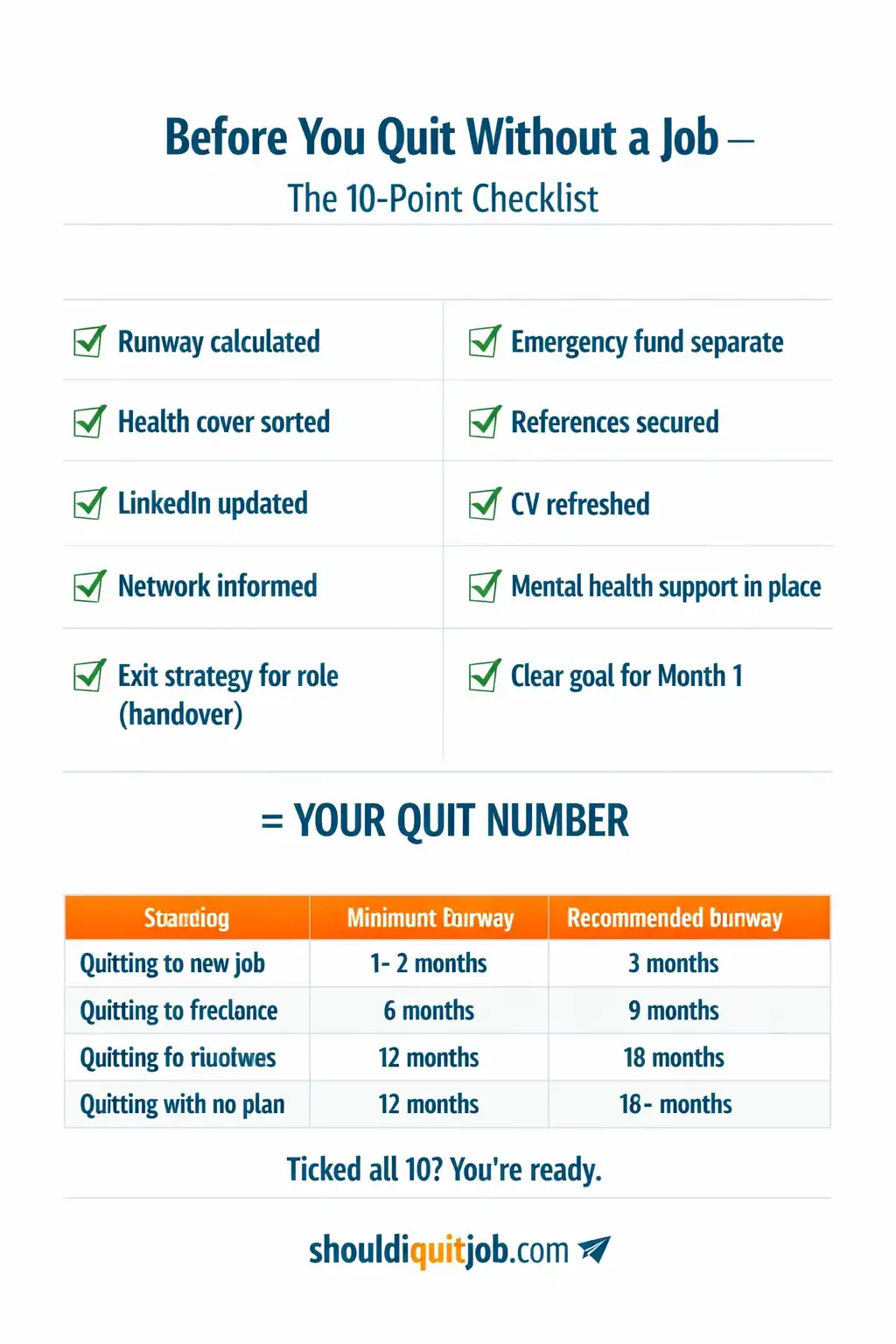
Ten Things to Do Before You Hand In Your Notice
- Work out your real runway. Monthly expenses times the months you’d need, plus another 20 percent on top. Know the number cold.
- Save a separate emergency fund on top of that runway, not carved out of it. A surprise cost during a job search shouldn’t force your hand.
- Figure out your health coverage before you leave, not after. In the US especially, know exactly what happens to your insurance the day you walk out.
- Lock in your references while you’re still employed and on good terms. Don’t assume a former manager will reply quickly once you’re already mid-search.
- Update your resume and LinkedIn now, while you still have your title and access to the details of what you actually did. Quietly, but before your last day.
- Tell two or three people you trust that you’re planning to move on. Not a big announcement, just a heads-up. Those conversations land much better before you’re visibly desperate.
- Write down exactly what you’re owed. Final paycheck, unused leave, any vesting or notice pay. Know the full number coming to you.
- Line up support if mental health is part of this. A therapist or doctor already in the loop before you leave makes the transition easier than most people expect.
- Sketch out what month one actually looks like. Not a whole plan, just some rest, some structure, and a real date when active searching starts.
- Decide your exit story ahead of time. A short, honest, non-heavy answer to “why did you leave?” “I wanted to make a deliberate move instead of a reactive one” works, because it’s true.
What the First 60 Days Tend to Look Like
The first two weeks are usually relief and disorientation, both at once. The relief is real. So is the strange gap where your job used to sit, especially if it was a big part of how you saw yourself. Let it feel odd for a while.
By weeks three and four, build some structure back in. The biggest trap here is letting your days go shapeless. A morning routine, regular movement, a start time even with nowhere to be, all of it protects you during a stretch that can otherwise drift.
Around day 31, start actively searching. Not before, for most people the rest genuinely matters first. By day 45 you should know roughly what you’re going for and be putting in real applications.
By day 60, take stock. Are applications going out consistently? Are you hearing back? Are first interviews happening? If not, something needs adjusting, whether that’s your targeting, your resume, or the market itself.
Most people who navigate this well end up treating the search like a job in its own right: a start time, a daily target, a weekly check-in. Just not from day one.
One Last Thing
Quitting without a job lined up doesn’t have to be reckless. Done with the right prep, it can be one of the more strategic moves you make.
The people who end up regretting it rarely regret leaving. They regret leaving before the practical groundwork was actually in place.
Get the groundwork in place first. Then go.
Ready for your answer?
Get a data-backed verdict in 2 minutes
13 questions. Personalised Leap / Wait / Stay verdict. Financial runway analysis. Basic report free · Full analysis available · No login required.
Analyse My SituationThis content is for informational purposes only and does not constitute professional financial, career, or psychological advice. If you're experiencing symptoms of depression, anxiety, or burnout, please speak with a qualified health professional.