What to Do in the First 7 Days After Quitting
A day-by-day action guide for the week after you leave. What to sort, what to skip, and how to set up the weeks that follow.
You handed in your notice. Now your last day has come and gone.
Feeling relieved, unmoored, and a little lost all at once on day one is completely normal. Here’s how to spend the first week in a way that actually sets up everything after it.
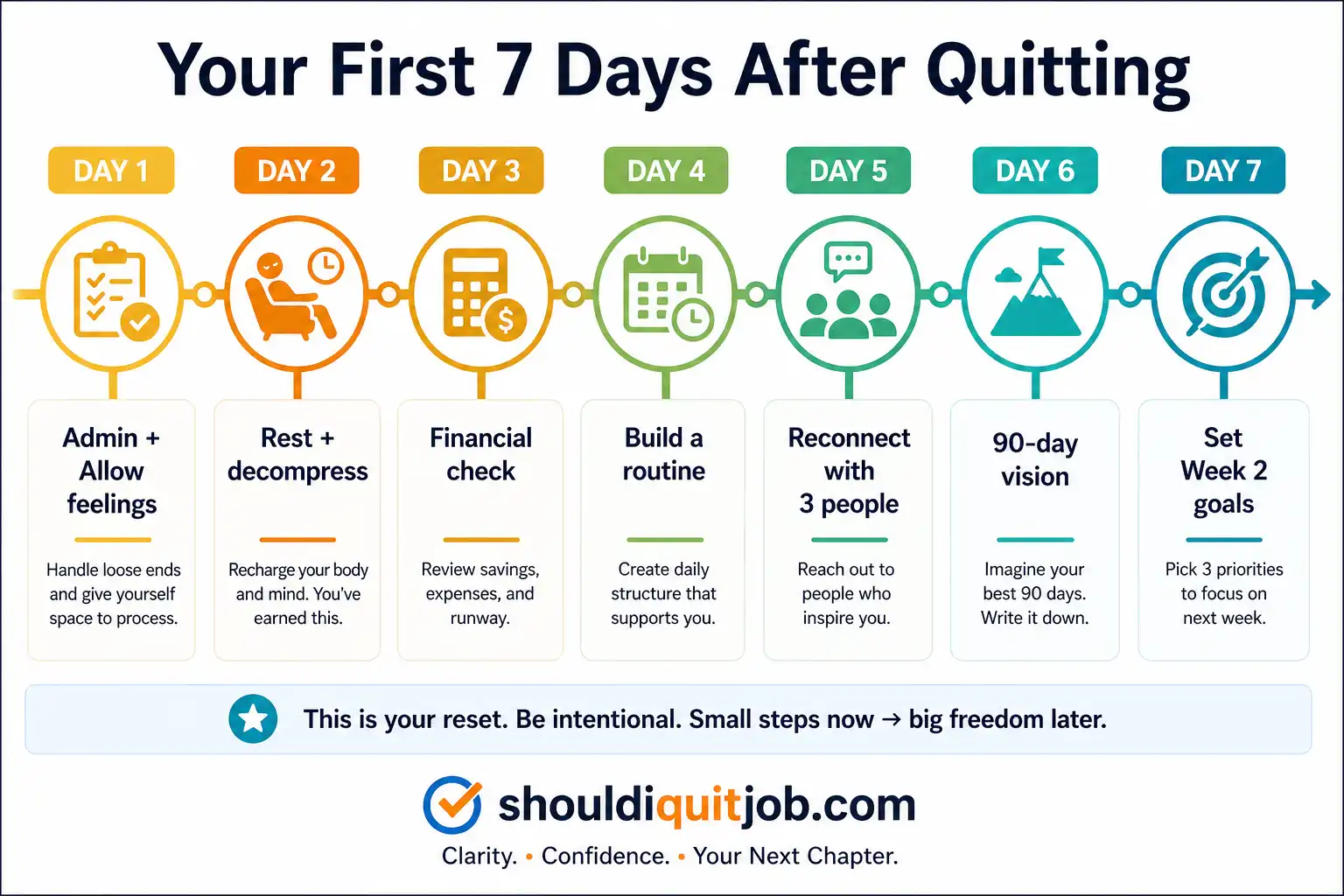
Day 1: Handle the Admin, Then Let Yourself Exhale
The first morning without a job to go to usually feels lighter and stranger than you expected, sometimes both in the same hour.
Get the practical stuff done first, while you still have the energy and access to do it.
Check when your final paycheck lands and what it covers, including any unused leave you’re owed.
Hand back any equipment if you haven’t already - laptop, phone, access card. Obvious, but plenty of people end up holding onto this stuff for weeks without meaning to.
Update your passwords. Not to shut the company out, but to close the loop on any personal accounts you were logging into through a work email.
Save anything that’s actually yours. Performance reviews, references, samples of work you’re allowed to keep. Do this before any accounts get switched off.
Then stop. Give yourself the rest of the day off, genuinely. You don’t have to map out your future this afternoon. The job took up a lot of headspace for a long time - day one is just about starting to get it back.
Day 2: Rest, Without Feeling Guilty About It
Day two is for actual rest. Not scrolling job listings while telling yourself it’s relaxing.
If there’s someone you’ve been meaning to see, today’s a good day for it. Lunch, a walk, anything that has nothing to do with work or what’s next.
Fight the urge to be productive. This isn’t laziness, it’s recovery. Most people leaving a job that wasn’t working for them are more worn down than they realize, and the rest isn’t wasted time.
One exception: if the job took a real toll on your mental health, call a doctor or therapist today instead of putting it off. It’s easier to get support in place early than to catch up later.
Day 3: Look Squarely at the Money
Day three is for getting an honest read on where you stand financially.
What do you actually have saved? What goes out each month? At that rate, how many months can you cover before you need income again?
This isn’t a day for panic, it’s a day for clarity. Knowing your real number beats carrying around a vague guess. If it’s smaller than you hoped, better to know now while you have the most time to react. If it’s bigger, that’s real reassurance.
Update your monthly budget too, since some costs disappear without a job - commuting, lunches out, work clothes. The new number is often lower than people expect.
Day 4: Put Some Shape Back Into Your Days
Day four is when structure starts to matter.
Time without a schedule has a way of expanding to fill itself, and not always usefully. People who look back on this period feeling good about it almost always built some routine early on.
That doesn’t mean a packed schedule. It means a few simple things.
A real wake-up time - not your old work alarm, but not sleeping until noon either.
A clear point where the day’s activity starts, after however you like to ease in.
A clear point where it ends, so evenings still feel like evenings. This matters more once nobody’s setting the boundary for you.
None of this is about being productive yet. It’s just about giving the day a shape you can actually live inside.
Day 5: Reach Out to Three People
Not to ask for a job. Just to reconnect.
Pick three people you actually want to stay in touch with - an old colleague, someone in your field, a contact you’ve lost track of. Send a short, honest message. Something like “I just left [company] and would love to catch up sometime” says everything it needs to.
This isn’t networking with an agenda. It’s just maintaining relationships, and the people who land well tend to be the ones who kept these connections warm before they needed them. Day five is where that starts.
Day 6: Sketch Out the Next 90 Days
By day six, most of the initial decompression is done and some clarity is starting to show up.
Grab a notebook and sit with one question: what would count as a good outcome 90 days from now?
Not “what do I want out of life.” Too big, too vague. Just 90 days. A job offer accepted? A freelance client signed? A clear decision made, either way? Pick something you could actually point to and say “yes, that happened.”
It doesn’t need to be your final answer. It just needs to be specific enough to work backward from. “I want clarity on what’s next” isn’t a goal, it’s a feeling. “I want to have had five real conversations in [field] and know whether it’s worth pursuing” is a goal.
Write your 90-day answer down. Then name three things that need to happen next week to move toward it.
Day 7: Set Up Week 2
The last day of week one is about shifting from recovery into momentum. If you’re still weighing your options, the two-minute assessment can help sharpen the picture before week two starts.
Pick three specific goals for next week, not a full plan, just three things. Applications sent, conversations had, a draft written, a skill you started learning. Small enough to actually finish.
Then decide when the active phase begins. If a week of rest was enough and you’re feeling steady, week two is a reasonable time to start moving. If you need more time, take it - just pick an actual date rather than letting it drift.
The first week isn’t about getting everything right. It just needs to end with you facing forward again.
Ready for your answer?
Get a data-backed verdict in 2 minutes
13 questions. Personalised Leap / Wait / Stay verdict. Financial runway analysis. Basic report free · Full analysis available · No login required.
Analyse My SituationThis content is for informational purposes only and does not constitute professional financial, career, or psychological advice. If you're experiencing symptoms of depression, anxiety, or burnout, please speak with a qualified health professional.