Stay, Switch, or Quit? The 3-Path Career Model
Most people treat this as a binary decision: stay or quit. It isn't. The option most people skip is often the one that actually solves the problem.

You’ve been going back and forth on this for weeks. Maybe months.
Stay or quit. Quit or stay. You run the numbers, talk yourself into it, talk yourself back out, and land in the same spot every time.
Here’s why: you’re choosing between two options when there are three.
Most people treat this as a coin flip. It isn’t. The option almost everyone skips is often the one that solves the actual problem, without the financial risk or the regret of picking wrong.
Path One: Stay, But Fix One Specific Thing
This isn’t “grit your teeth and hope it gets better.” That’s suffering with extra steps.
A real version of staying means naming what’s broken, making a plan to fix it, and setting a real deadline, 90 days, six months, to see if it worked. Nothing changed by then, you move.
It works when the problem really is one fixable thing. A difficult manager who’s likely leaving soon. A project finally winding down. A pay gap you’ve never asked about. A team dynamic one honest conversation could shift.
Right for you if your unhappiness traces back to something specific, not the work, not the whole culture. One thing. You’ll usually know within one to three months whether it worked, and it costs nothing financially: income, benefits, and momentum stay exactly where they are.
Karan spent eight months miserable at his marketing agency and was ready to walk. But when he wrote down what was bothering him, most of it traced back to one client he found ethically uncomfortable. He asked to be moved off the account, his manager agreed, and three months later it felt like a different job entirely.
Wrong for you if you’ve already tried the obvious fixes, if it’s the whole environment rather than one piece of it, or if your health is paying the price for every extra month you stay.
Path Two: Switch Employers, Keep the Work
This is the most overlooked path, and for a lot of people, it’s the right one.
If the work suits you but the company doesn’t, you don’t need to leave the field. You need to leave that employer. That’s a smaller decision than it feels like from the inside.
Switching means leaving from strength. Income keeps coming while you search, there’s no resume gap, and you move with leverage instead of desperation.
This fits people who like the kind of work they do but can’t stand where they’re doing it: the culture, the leadership, how decisions get made.
Most skilled professionals manage this in two to four months: search while employed, land an offer, then resign. You might take a short-term pay cut to land somewhere healthier, or come out ahead. Either way, income never stops.
Rachel spent six years in financial services, good at the work and well aware of it. What wore her down was the politics at her firm, the credit-stealing, the sense that visibility mattered more than good work. She job-searched quietly, found a smaller firm with a different reputation, and moved. Same field, completely different experience. She didn’t need to leave finance, just that firm.
Wrong for you if you’re burned out on the work itself, if the same problems keep following you across employers, or if the whole industry no longer fits what you want.
Path Three: Quit
Sometimes the honest answer really is to leave. No modifier.
That’s true when the work itself is wrong for you. When your health is being damaged and staying isn’t neutral. When you’ve genuinely tried the internal fixes and nothing moved. When your values and the company’s simply don’t align.
This fits people whose problem can’t be solved from the inside, who have the runway to leave safely, and have a rough sketch of what comes after.
Relief tends to be immediate. Clarity usually takes four to twelve weeks. This is the highest-risk path by far, and how much runway you need depends on what comes next:
| Your next step | Minimum runway | Recommended |
|---|---|---|
| New job lined up | 1 month | 3 months |
| Job search with no offer | 3 months | 6 months |
| Freelancing or consulting | 6 months | 9 months |
| Starting a business | 12 months | 18 months |
| No plan yet | 12 months | 18+ months |
Neha had practiced law for nine years, and she was good at it. She was also miserable in a way that had nothing to do with her firm and everything to do with the work itself. She’d known it for three years, and every internal move just delayed the same conclusion.
She saved hard for 18 months, then left. Career exploration, a product management course, and a startup job followed. The pay cut was real, and so was the change in how she felt day to day. No amount of switching firms would have fixed that.
Wrong for you if your runway is under three months, if you’re leaving out of anger after a rough week, if you have no sense of what comes next, or if the problem is fixable and you haven’t tried yet.
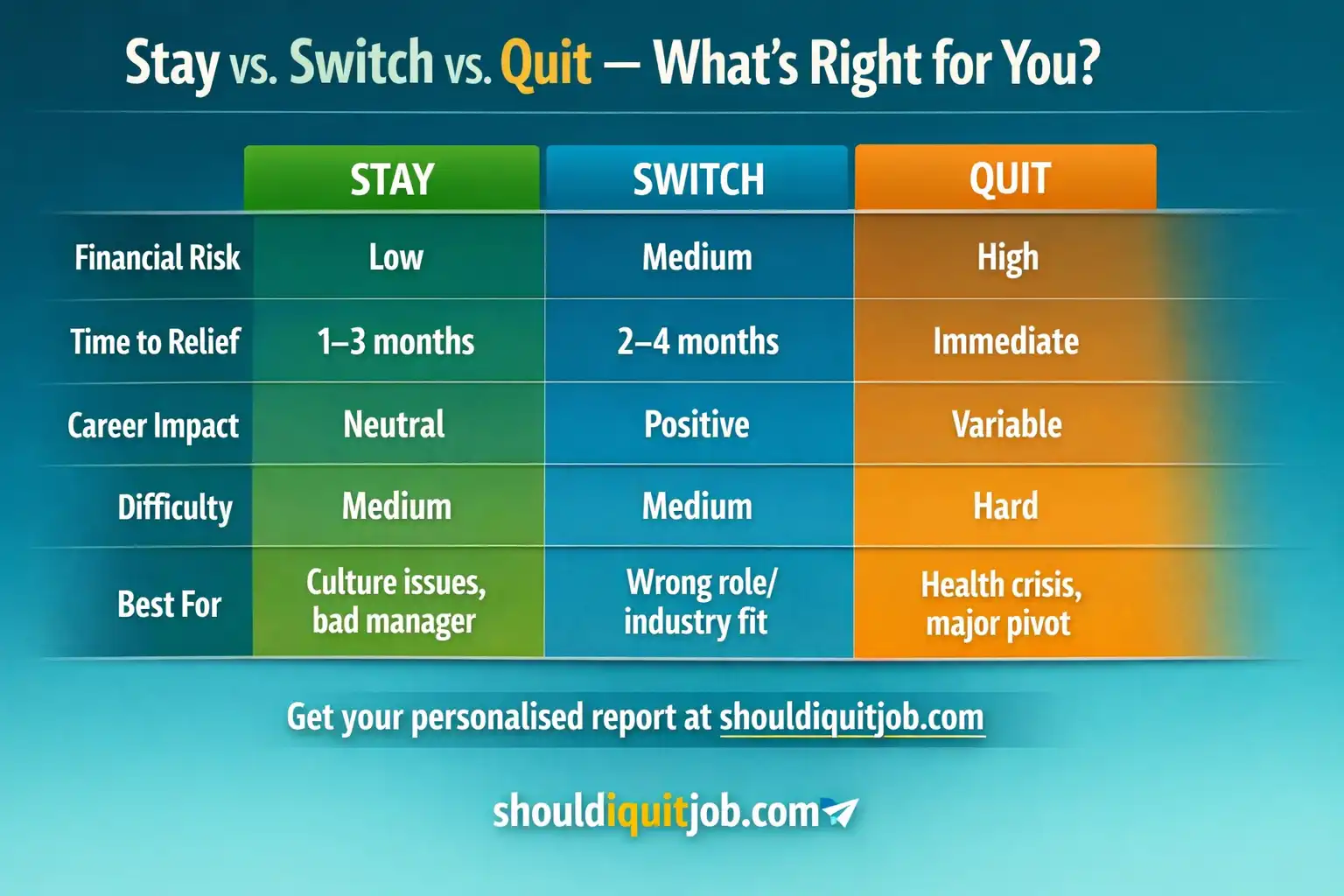
The Comparison at a Glance
| Factor | Stay | Switch | Quit |
|---|---|---|---|
| Financial risk | Low | Medium | High |
| Time to relief | 1 to 3 months | 2 to 4 months | Immediate |
| Career impact | Neutral | Usually positive | Variable |
| Income continuity | Yes | Yes | No |
| Difficulty | Medium | Medium | Hard |
| Best for | One fixable problem | Wrong company, right work | Wrong work, health at risk, major pivot |
Three Questions to Find Your Path
Is the problem specific and changeable? Name the single biggest thing making you unhappy. Could it change here within six months? If yes, stay and try. If no, move on.
Do you like the actual work, or just the idea of it? Strip away the company, the manager, the commute. Just the tasks. Enjoy that, and the company’s the problem, switch. If the work itself is wrong, quit.
What’s your runway, really? Monthly expenses against savings. Under three months means you’re not ready yet, whatever your gut says. Build the number before the plan.
One More Thing
Most people stuck on this decision aren’t confused. They already know the answer and don’t want to deal with what comes after it.
If one of these three paths kept pulling at you while you read, that’s probably the real one. This model isn’t meant to manufacture a decision. It’s meant to give you enough clarity to trust the one you’re already leaning toward.
Rather work through it with structure than instinct? The assessment covers the same ground and gives you an actual verdict.
Ready for your answer?
Get a data-backed verdict in 2 minutes
13 questions. Personalised Leap / Wait / Stay verdict. Financial runway analysis. Basic report free · Full analysis available · No login required.
Analyse My SituationThis content is for informational purposes only and does not constitute professional financial, career, or psychological advice. If you're experiencing symptoms of depression, anxiety, or burnout, please speak with a qualified health professional.