Should I Quit My Job? The Complete 2026 Guide
A clear-eyed guide to the hardest career decision you'll make. Covers the 3-path model, the 5 factors that matter, and a framework you can use today.
 decision framework for career changes](/images/blog/should-i-quit-my-job-complete-guide.webp)
It’s Sunday evening. You told yourself you’d relax by now.
You haven’t. There’s a low hum of dread in your chest, and it gets louder the closer Monday gets. You check Slack for no reason. Nothing new is there. You’re just bracing.
You close the laptop, think about quitting and what that would cost you, then open it again.
If that’s you, you’re not being dramatic and you’re not weak. You’re stuck in a loop a lot of people are stuck in: a genuinely hard decision, with no clear way to think it through.
Here’s how to think it through.
Why This Decision Feels So Hard
You probably already know something needs to change. So why haven’t you decided yet?
Three reasons. None of them are your fault.
- You’re counting the years you’ve already put in. Leaving feels like throwing them away. But those years are gone either way - the only real question is what the next few look like.
- Losing feels worse than gaining feels good. A stable paycheck, a routine you know, a commute you could do half asleep - giving those up feels bigger than it should, even when the other side is clearly better. That’s not you being irrational. It’s just how people are wired.
- Your job has quietly become part of your identity. “I’m a manager at X.” Quitting doesn’t just mean a new job. It can feel like losing a piece of who you are, and that weighs more than most people admit.
Once you can name these three, stop mistaking them for wisdom. They’re not telling you to stay. They’re just noise.
There Are Three Options, Not Two
Most people treat this as stay-or-quit. That’s exactly why it feels impossible - you’re missing a whole option.
The 3-path model splits it into three: stay, switch, or quit. Most people jump straight from “unhappy” to “quit” without weighing the option in between.
1. Stay - but fix something specific
A real Stay isn’t “grit your teeth and hope.” It means naming exactly what’s broken, making a plan to fix it, and setting a date to check whether the plan worked.
It’s worth trying when the problem is fixable. A manager who’s likely moving on. A brutal project that’s almost over. A pay gap you haven’t actually asked about yet.
Priya was ready to walk away from her UX job at a fintech company. When she broke down where the misery actually came from, it was almost entirely one person - a manager who took credit for her work. She asked for a transfer instead of quitting. Awkward for a week, then fine. Same company, different team, completely different job.
The company was never the problem. One person was.
2. Switch - same field, different employer
This is the option people skip the most. If the work itself is fine but the company is wrong, changing employers usually fixes it without the financial risk of quitting outright.
You keep earning. You leave on your own terms instead of at a breaking point. And on paper, it just looks like a normal step up.
James spent eight years at a consulting firm. He wasn’t tired of the work - he was tired of always being billable and managing client politics all day. He moved to a product company for slightly less money and said it was the first job he’d actually looked forward to in years.
He didn’t need to leave the industry. He needed to leave that building.
3. Quit
Sometimes the job itself is the problem, or it’s affecting your health in a way that isn’t neutral to wait out, or you’ve saved enough to take a real break and figure out what’s next.
This path carries the most risk, and also the most upside. Most people who regret quitting don’t regret leaving - they regret leaving before they were ready.
Five Things That Actually Tell You Something
Not a bad week or a mood. These five things.
1. Your money
This is the biggest factor, and the one people are laziest about checking.
Work out your quit number before you decide anything else. It’s your monthly expenses, times however many months of runway your situation calls for, plus a 20 percent buffer on top.
Here’s roughly how much runway different situations need:
| Situation | Minimum | Recommended |
|---|---|---|
| Quitting into a new job | 1 month | 3 months |
| Quitting to freelance | 6 months | 9 months |
| Quitting to start a business | 12 months | 18 months |
| Quitting with no plan | 12 months | 18+ months |
Most people also forget what leaving costs beyond the paycheck - health cover, retirement contributions, any allowances your employer covers. Budget another 15 to 25 percent for that.
Do the math first. Everything else gets easier once you have.
2. What it’s doing to your health
There’s a real difference between “this job is stressful” and “this job is making me unwell.”
Here’s a rough test: do your symptoms track your work schedule? If sleep, mood, or anxiety noticeably improve on holidays and worsen during work weeks, the job is the trigger - and that’s not a neutral thing to keep tolerating.
3. Whether you’re actually building anything
Is this role teaching you something? Growing who you know? Making your next move easier?
If not, staying isn’t just unpleasant - it’s a quiet cost. Every year in a role that isn’t building anything is a year you didn’t spend building toward what’s next.
4. Your relationship with your manager
Your day-to-day manager shapes your experience at work more than almost anything else does. A good manager at an average company usually beats a bad one at a famous one.
Be honest here: is this one difficult person who might move on, or is the problem baked into how the whole place runs? That answer changes which of the three paths actually fits.
5. Where this job is actually taking you
Where do you want to be in three years? Is staying here moving you toward that, or further away from it?
You don’t need a five-year plan, just an honest answer. A job that isn’t moving you anywhere isn’t neutral - it’s a cost, even when it doesn’t feel like one day to day.
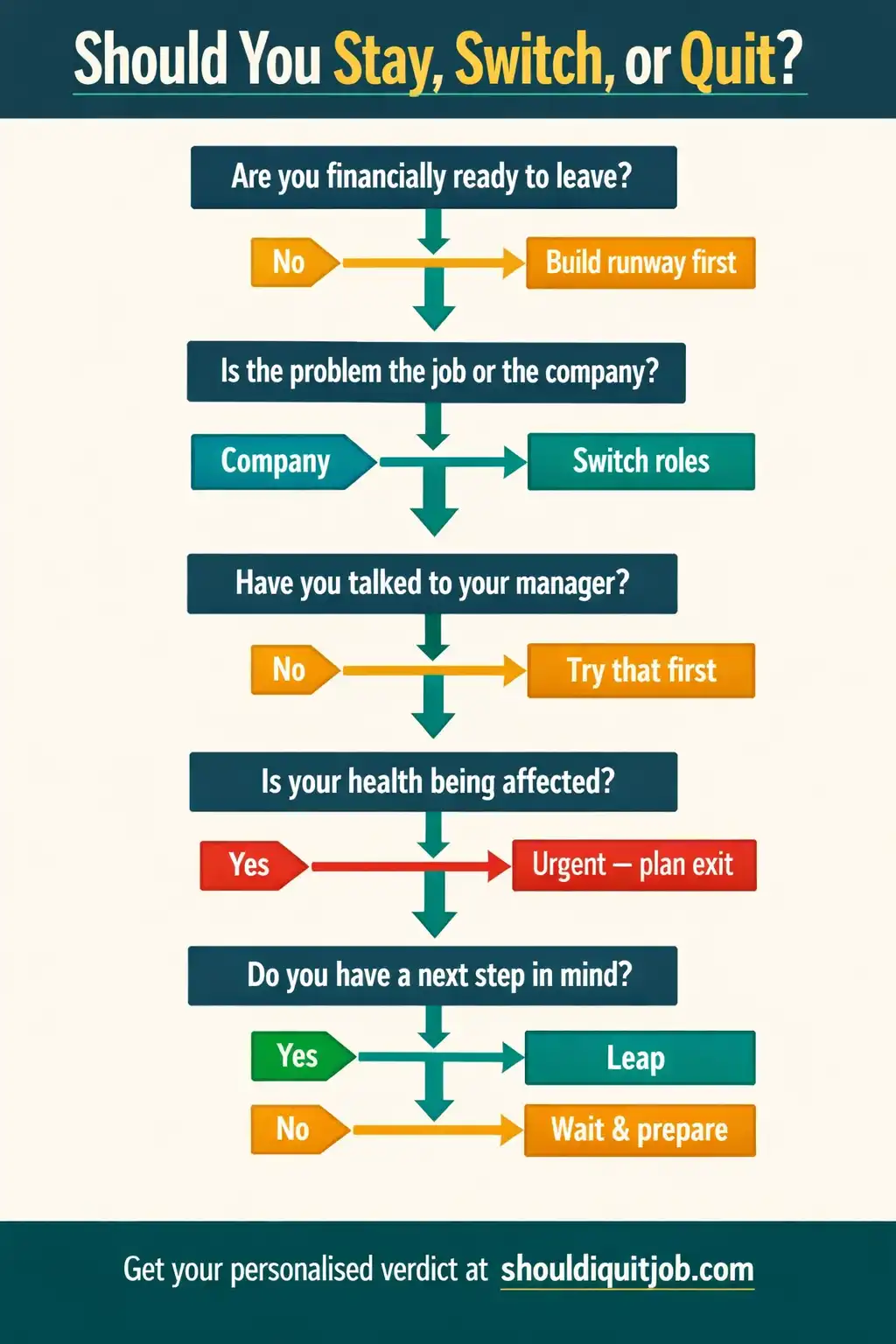
Signs It’s Probably Time to Go
- Your body follows your work schedule. Headaches that show up Monday and vanish by Friday. Sleep that gets better the second you’re on leave. That’s not you being dramatic.
- You’ve already tried to fix it. The conversation happened. The request went in. Nothing changed six months later.
- What the company stands for and what you stand for don’t line up. Not slightly different - genuinely incompatible. Time doesn’t close that gap.
- People you respected have quietly left. When colleagues whose judgment you trusted start exiting without much fanfare, pay attention.
- Sunday dread has lasted more than three months. One rough Sunday is a hard week. Three months of them is a pattern.
- You feel actual relief just imagining leaving. Not “that’d be nice” - real, physical calm at the thought of not walking back in. That’s information.
Signs You Should Probably Wait
- The problem is one person who might not be around much longer. If a difficult manager is most of the pain, and there’s a real chance they leave within six months, giving it that long can make sense.
- You haven’t actually tried the internal options. A transfer, a renegotiation, a different project. Not always possible, but often not even attempted.
- Your runway is under three months. Don’t wait forever, but build the number before you go. Leaving broke narrows every choice you’ll have next.
- You genuinely don’t know what’s next. Quitting toward something vague beats quitting into nothing at all. Give yourself 90 days to get some clarity first.
- You’ve been there less than a year. Not a dealbreaker, but two short stints back to back raises eyebrows later.
If You’re Thinking About Quitting This Week
Something happened. A bad review. A humiliating meeting. Or just the last straw after months of smaller things piling up. Now it feels urgent.
Don’t make a permanent call from a temporary state. That doesn’t mean stay - it means give it 48 hours. Sleep on it. Talk to one person who actually knows your situation. Then look back at the five factors above with a clearer head.
If the feeling is still there after 48 hours, that’s probably real - whatever happened just triggered something that was already true. If the urgency fades, you likely still have a real problem; it’s just the timing that changes.
One exception: if your safety, dignity, or legal rights are on the line, don’t wait. Protect yourself first.
Three Questions That Cut Through the Noise
Still stuck after all that? Try these.
If you could change exactly one thing about your job, what would it be? A concrete, fixable answer usually points to Stay or Switch. “Everything” usually points to Quit.
What would you tell a close friend in your exact situation? You’re much better at advising other people than yourself. Write the advice out as if it’s for a friend, then read it back.
If money weren’t part of the equation, what would you do? Fear about money often hides your actual preference. Take it out of the picture for a second. Whatever you land on tells you what you actually want - the rest is just building the conditions to get there.
What To Do With Your Answer
Staying? Make it deliberate. Write down what needs to change and by when. Start building your runway anyway, just in case. A chosen Stay looks nothing like simply enduring.
Switching? Start quietly. Update your CV before you say anything at work. Reach out to your network before you have a pressing reason to. The best moves happen from security, not a scramble.
Quitting? Get the practical stuff sorted first. Know your quit number. Line up your references. Have a rough sketch of what month one looks like. People who regret quitting almost never regret the decision itself - they regret leaving before they were ready.
Want a More Specific Answer?
Everything above is a framework. It works best with real numbers behind it, and your own numbers are usually the hardest thing to see clearly on your own.
The tool on this site asks about your finances, burnout, how well the job fits you, and how much risk you can handle. You get a Leap, Wait, or Stay verdict, a runway breakdown, and a short list of what to actually do next.
Free basic report, deeper version available, about two minutes, no login needed.
This guide is for informational purposes only. It is not professional financial or career advice. For decisions with significant financial or health implications, please speak with a qualified professional.
Ready for your answer?
Get a data-backed verdict in 2 minutes
13 questions. Personalised Leap / Wait / Stay verdict. Financial runway analysis. Basic report free · Full analysis available · No login required.
Analyse My SituationThis content is for informational purposes only and does not constitute professional financial, career, or psychological advice. If you're experiencing symptoms of depression, anxiety, or burnout, please speak with a qualified health professional.